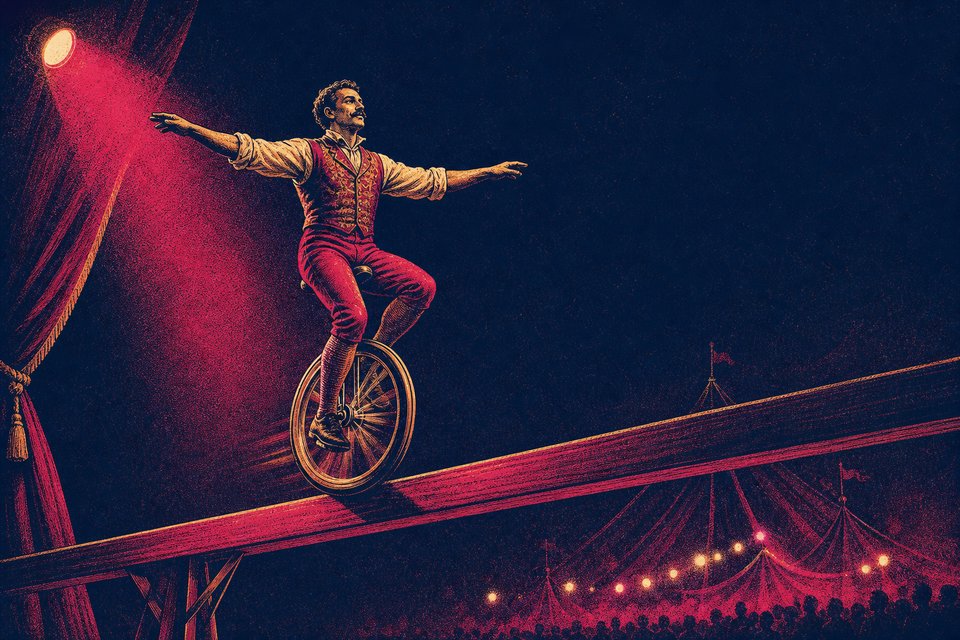
Balance
Unicycle in New Zealand — Learning to Ride and Where to Practise
The circus skill with the steepest entry and the sharpest breakthrough.
Unicycling is the least forgiving circus discipline to begin and one of the most satisfying in the whole art form to finally crack. There is no gentle gradient of partial success along the way: for several weeks you simply cannot ride at all, and then quite suddenly one afternoon you can.
That shape puts a lot of people off before they get anywhere, which is a genuine shame, because the total time involved is much smaller than the accumulated frustration suggests. Ten to twenty hours of practice is an entirely normal figure, and persistence rather than athleticism decides who gets there.
How learning actually progresses
The sequence is mount, sit, pedal, then steer, and it is well worth separating those four elements deliberately. Beginners who insist on trying to mount unaided from the very first day end up spending every session on the hardest single element and never accumulate any real time in the saddle.
Using a wall or a rail solves this problem almost entirely. Hold on, get properly seated, and pedal along the support until the seated position stops feeling like a continuous emergency. Only once that is comfortable is it genuinely worth spending whole sessions on the free mount, and the fastest learners resist trying the free mount early.
Separate the four elements
Riders who progress fastest treat these as four genuinely separate problems rather than as one single problem. The mount is the hardest of the four and the least useful to attempt early on, which is why a wall or a rail is worth far more in the first fortnight than any amount of determination.
- Mount, assistedHold a wall or rail, get seated, and let the support do the balancing. The free mount comes much later.
- SitStay in the saddle without the position feeling like an emergency. Until this is comfortable, nothing above it will hold.
- PedalTravel along the support in a straight line. Saddle height matters here — near-straight leg at the bottom of the stroke.
- Steer, then idleLeaving the wall, turning, and finally rocking on the spot to hold position without travelling.
Choosing a first unicycle
A twenty-inch wheel is the standard adult learner size and there is little reason to deviate from it. It rolls slowly enough that a correction can actually catch a wobble before it becomes a fall, and the shorter travel per pedal stroke keeps the whole machine within a range you can recover.
Bigger wheels are for distance riding and properly belong to a later stage entirely. Saddle height matters considerably more than most beginners expect: set it so that the leg is almost straight at the very bottom of the pedal stroke, exactly as you would on a bicycle, and a beginner on one spends every ride recovering from corrections.
Where the skill is taught
Unicycle sits in the balance stream alongside tightwire and stilts, and it turns up far more often in community circus programmes than in the commercial aerial-focused studios. Social circus organisations have long taught it as one part of a general skills rotation rather than as a specialism, and its absence from commercial timetables reflects studio economics.
It is also one of the very few circus disciplines that is genuinely self-teachable, given a machine and a suitable wall. Instruction shortens the process considerably and corrects posture early, but plenty of competent riders have arrived at it entirely on their own with nothing but stubbornness, and that independence explains its devoted following.
Who teaches balance skillsLook for the community trusts in the directory — the all-abilities and community programmes are where stilts, tightwire and unicycle most reliably appear.
Questions people ask
How long does it take to learn to ride a unicycle?
Most people ride a short distance unaided after somewhere between ten and twenty hours of practice spread across several weeks. Progress is unusually stepwise compared with other skills: very little appears to happen for a long stretch, and then riding arrives almost all at once, usually within a single session.
What size unicycle should a beginner get?
A twenty-inch wheel is the usual learner size for adults, because it is slow enough to control and small enough to correct when it starts going wrong. Larger wheels travel faster and further but punish exactly the sort of mistakes absolute complete beginners make constantly in their first few weeks.
Do I need a wall to learn against?
A wall, rail or fence is close to essential for the first several sessions of learning. It lets you practise the seated position and the pedalling without spending every single attempt on the mount, which is a genuinely separate skill best tackled once you can already ride, and skipping it is why most people quit within a fortnight.
Is unicycling taught in New Zealand circus classes?
It appears in the balance stream at several schools and turns up regularly in community circus programmes, though less commonly as a standalone course with its own timetable slot. Social circus organisations have historically taught it alongside stilts and tightrope as part of a general rotation, and a community programme is the easiest place to try one before buying anything.