Getting started
Circus Classes in New Zealand — How to Find One and How to Choose
What a beginner term actually involves, before you book it.
Circus classes in New Zealand follow a fairly consistent shape regardless of which city you happen to be in. Schools sell terms of eight to ten weeks, stream adults separately from children wherever numbers allow it, and start their beginners on conditioning work well before letting them near the apparatus.
What varies between them is emphasis rather than structure. Some studios are aerial specialists to the exclusion of everything else, some teach the full spread from juggling through to handbalancing, and community trusts consistently prioritise access over technique. Knowing which sort you have walked into can save an entire wasted term.
Classes by city
- AucklandThe largest choice of schools, spread across the central suburbs and the North Shore.Tāmaki Makaurau
- WellingtonA central training base plus a youth specialist in Porirua.Te Whanganui-a-Tara
- ChristchurchA community circus centre and an independent school, both taking adults and children.Ōtautahi
- Everywhere elseNorthland, Napier, Raglan and the touring companies, in the national directory.Nationwide
What the first term looks like
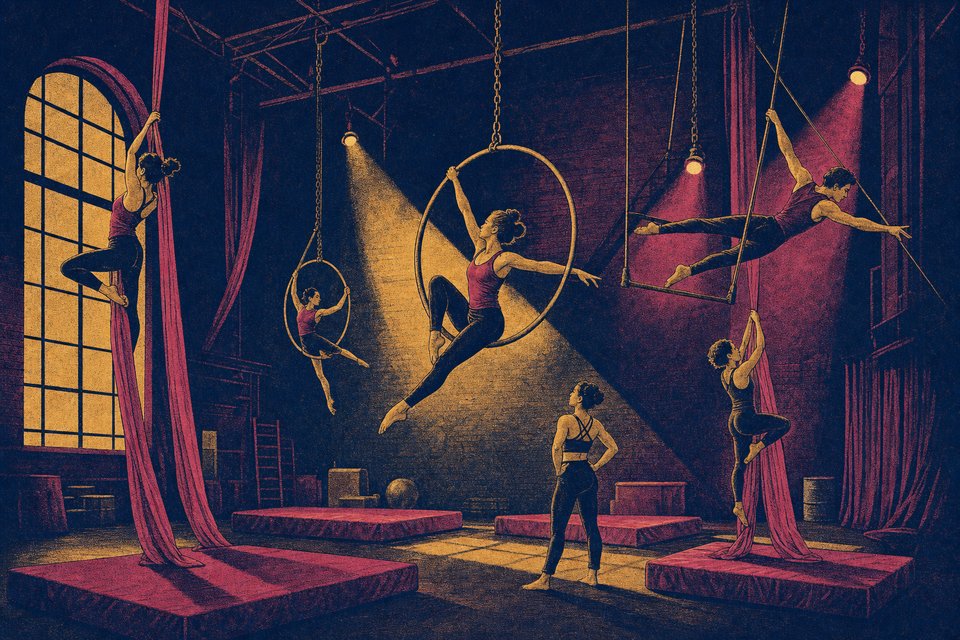
The opening weeks of any beginner term are mostly conditioning and safety work rather than anything photogenic. You learn how to grip properly, how to hold a hollow body position, how to invert without swinging wildly, and how to come back down under full control. Very little of it resembles performance.
Grip endurance is the usual limiting factor for beginners, and it improves considerably faster than most students expect it to. Most people find that the thing which felt flatly impossible in week one has become merely difficult by week five, and that is the point at which the training starts to feel worthwhile.
The three main centres compared
Each of the three main centres supports a noticeably different shape of provision, and the difference is worth knowing before you commit to travelling across a city twice a week to reach one. The table below sets out how many organisations are listed in each and what that centre is genuinely strongest at.
| Centre | Listed | Strongest in | Dedicated youth stream |
|---|---|---|---|
| Auckland | 5 | Aerial, with real choice of studio across the city and the North Shore | Yes |
| Wellington | 2 | One central training base, little duplication | Yes, in Porirua |
| Christchurch | 2 | Community access, open training and a broad apparatus list | Yes |
Terms, blocks and casual rates
Almost every school in the country prices the same two ways. A casual rate buys a single session and lets you test whether the room and the teaching suit you before committing further. A term block covers eight to ten weeks at a lower rate per session and is how regular students actually pay.
The block is better value and worse for hedging, which is the whole trade-off. Booking a casual session first costs slightly more per hour but avoids the far more expensive mistake of paying for ten weeks at a studio whose teaching approach turns out not to suit you at all.
Community trusts sit outside that pattern. Their sessions are frequently free or heavily subsidised because their funding comes from grants rather than from fees, which makes them the sensible first approach for anyone for whom cost is the deciding factor rather than a consideration, and they are consistently the part of the sector that newcomers never think to approach first.
Picking a discipline before you pick a school
Strength and coordination transfer remarkably unevenly across the circus disciplines. Someone arriving with a climbing background will find aerial work straightforward and juggling frustratingly slow; a drummer very often finds precisely the reverse. Reading about the rigged apparatus first narrows the search down considerably before you spend any money at all.
Start with the skillShort guides cover aerial silks, hula hoop, juggling and unicycle — what each demands, and how long the first milestone takes.
Questions people ask
How do I choose between circus classes in different cities?
Travel time decides considerably more than reputation does, and it is the factor people most often underweight. Aerial circus training only produces results with genuine weekly consistency, so the nearest competent school almost always outperforms a more celebrated one that you end up visiting half as often as you intended.
What should I wear to a first class?
Close-fitting clothing that covers the backs of the knees, because aerial fabric and hoop grip against bare skin painfully enough to end a session early. Training is normally barefoot on the mats, and rings, watches and long nails all come off before you are allowed to touch any of the apparatus.
How long before I can do anything that looks like circus?
A single term is usually enough to climb, invert and hold a basic shape on aerial apparatus, or to run a stable three-ball cascade. Anything genuinely photogenic tends to arrive in the second or third term, once the underlying strength and timing have stopped being the limiting factor on progress.