Community
What Is Social Circus, and How Does It Work in New Zealand?
Circus used as a method rather than an ambition.
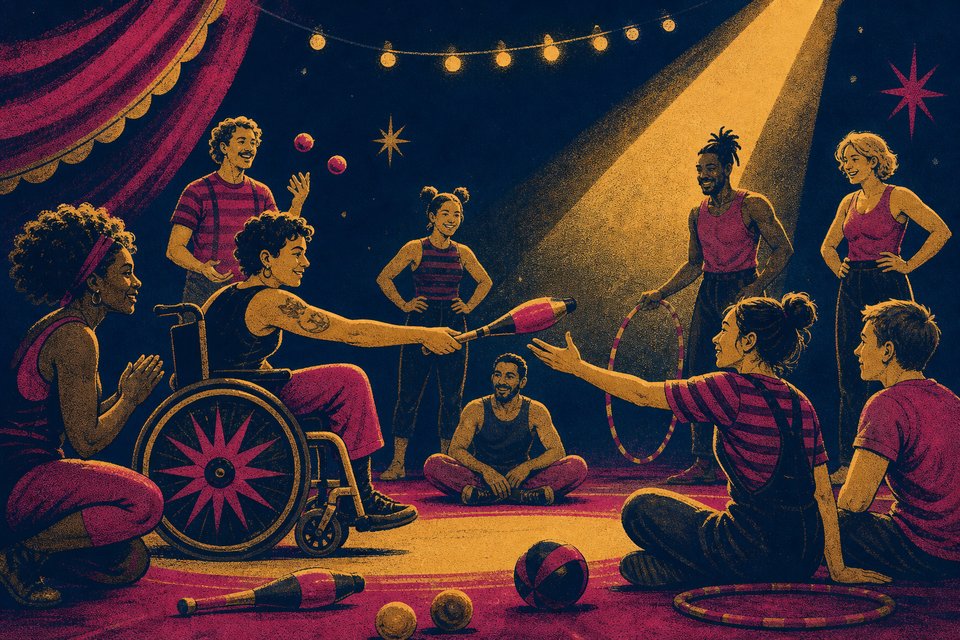
Social circus is circus skill used deliberately as a form of social work. The session itself looks broadly similar to any class — hoops, juggling clubs, a low tightwire — but the underlying purpose is participation, confidence and physical inclusion rather than technique aimed at eventually reaching a public stage.
That difference in purpose changes almost everything about how a session is actually run. Groups are mixed rather than streamed by ability, progress gets measured by involvement rather than by skill acquired, and nobody in the room is working toward an audition or a performance at the end of it.
Why circus specifically
Circus has an unusual property as a group activity that makes it particularly well suited to this work. It contains skills at every conceivable level of difficulty, and success within it is not comparative: a person spinning a hoop is not in any sense competing with the person juggling beside them.
That removes the ranking dynamic which makes conventional sport so difficult for people who have already been excluded from it once. It also means a mixed-ability room can work on completely different things simultaneously without anybody in it being visibly and publicly behind everybody else, and it is the structural reason it reaches people organised sport has already lost.
How it works in New Zealand
The work is carried by community trusts rather than by commercial studios, and it happens in community halls and school gymnasiums at least as often as in dedicated spaces with permanent rigging. Programmes currently run in Auckland, Christchurch, Northland and the Bay of Plenty among other regions, and the venue is very often a borrowed hall with portable equipment.
Funding is the structural constraint on all of it. Because sessions are free or heavily subsidised by design rather than by accident, the organisations depend on grants and philanthropy to continue, which makes their programme calendars less predictable than a commercial studio’s termly timetable, and a programme running strongly one year can pause the next without anything having gone wrong.
Who runs itThe community trusts doing this work are listed alongside the schools in the directory, with regional breakdowns for Auckland and Christchurch.
Social circus and a commercial class compared
From the doorway the two genuinely look almost identical, and that surface similarity is exactly what causes most of the confusion. The difference is one of purpose rather than of apparatus, and it changes how a session is grouped, how progress gets judged, and who ends up paying for any of it.
| Social circus | Commercial class | |
|---|---|---|
| Measure of progress | Participation | Technique acquired |
| Grouping | All abilities together, by design | Streamed by level and often by age |
| Cost model | Free or subsidised, grant-funded | Casual rate or a term block |
| Working towards | Nothing — the skills are the method | Shapes, sequences, sometimes performance |
| Usual venue | Borrowed community hall | Dedicated studio with permanent rigging |
| Route in | A support service or school partnership | Booked online in advance |
An international movement
The approach is not remotely local in origin. Comparable programmes run in dozens of countries, and practitioners actively exchange method between them, which is why a session running in a Northland hall is recognisably the same activity as one running in Montreal, Bogotá or Yangon, and practitioners here train alongside international colleagues in a method that travels almost unchanged.
It has also attracted genuine research attention over the years, with evaluations examining its effects on confidence, social connection and physical participation. That accumulated evidence base is a large part of why funders now treat social circus as a legitimate intervention rather than as subsidised recreation, and that literature is why funders now treat the work as an intervention.
Taking part
The entry route is quite different from that of a commercial school. Rather than booking a full term online and paying up front, participants usually arrive through a community organisation, a support service or a circus school partnership, and cost is very rarely the factor that decides whether they attend.
For anyone weighing up a first circus experience and put off either by studio pricing or by the performance framing of commercial classes, this is the part of the sector most likely to suit them, and simultaneously the part they are least likely to ever hear about, this is the part of the sector least likely to be advertised.
Questions people ask
What is social circus?
It is the use of circus skills as community and social work rather than as training aimed at performance. Sessions are built around participation, confidence and physical inclusion, and the skills themselves function as the method rather than as the goal that everyone is working steadily towards, and the distinction from a commercial class is one of purpose.
Who takes part in social circus programmes?
Typically disabled people, young people who have fallen outside mainstream sport, isolated older people, and mixed community groups of all kinds. Sessions are usually all-abilities by deliberate design rather than being streamed by ability level, which is a significant part of what makes them work at all, and the mix is usually broader than a commercial studio’s intake.
Is social circus the same as a circus class?
No, although the room can look almost identical from the doorway. A commercial class measures progress by technique acquired over a full term. A social circus session measures it by participation, and will happily spend a whole term on skills that a performance-focused school would move past in a fortnight.
Where does social circus happen in New Zealand?
Community trusts run programmes in Auckland, Christchurch, Northland and the Bay of Plenty among other places, and often in borrowed community halls rather than in dedicated studios with permanent rigging. The organisations doing this work are listed alongside the commercial schools in the national directory, and the organisations doing the work are listed alongside the commercial schools in the directory.